

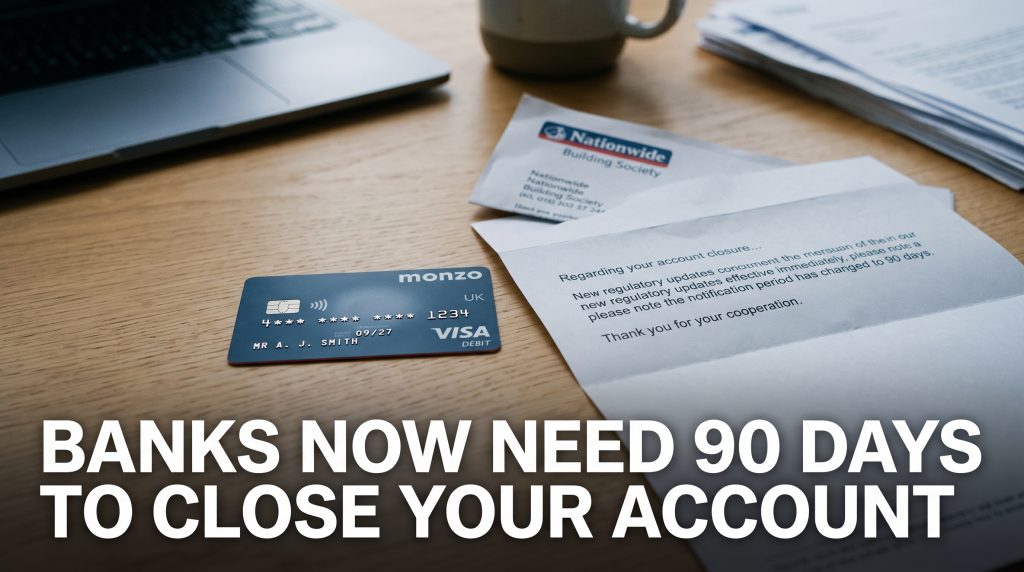
If you’ve run an international business through a UK bank account or EMI (Wise, Revolut, and similar), you’ve probably heard a version of the same story: an account closes with little warning and even less explanation. A new rule, taking effect on 28 April 2026, changes part of that picture.
What’s changing
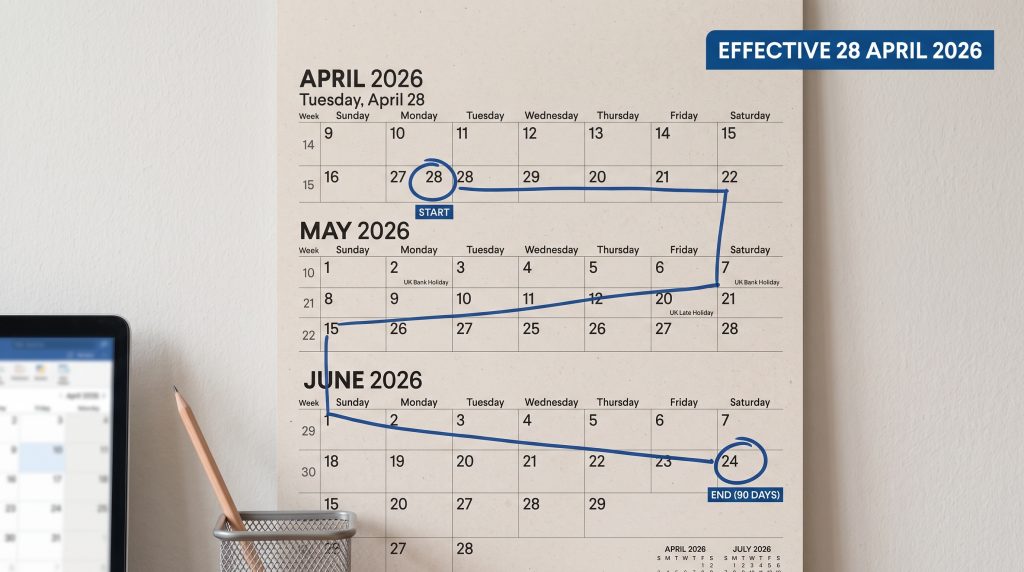
From 28 April 2026, UK banks must give customers at least 90 days’ notice before closing a personal account — up from roughly two months previously — and must provide a genuine, written reason for the closure. The change followed a government review into so-called “de-banking,” triggered in part by high-profile account closure cases that made headlines in 2025.
What it does fix
Ninety days is a meaningfully different amount of time than a few weeks’ notice. In practice, it means:
- Time to move funds in an orderly way rather than scrambling once an account is already frozen or closing.
- Time to notify suppliers, staff, and clients of a change in payment details.
- Time to open and properly test an alternative account before the old one stops working.
- A written reason to work from if you want to challenge the decision through the Financial Ombudsman Service.
What it doesn’t fix
This rule only applies to closing an account you already hold — it does nothing to address the far more common problem international and non-resident founders face: a bank simply declining to open an account in the first place. It also doesn’t apply to accounts frozen or restricted during an active fraud or anti-money-laundering investigation, which is the scenario behind most of the sudden, no-warning freezes founders report on forums like OffshoreCorpTalk.
A written reason also isn’t automatically a fair reason — it simply means the bank has to give you one, which at minimum removes the “we are looking into it” limbo that leaves founders unable to act.
What non-resident founders should actually do with this
Don’t treat the 90-day rule as a safety net that removes the need for a backup plan. It’s protection against one specific failure mode (a sudden account closure with no notice), not protection against being declined for an account at all, and not protection against a fraud-flagged freeze.
The practical response is the same as it’s always been, just with slightly more breathing room if the worst happens: keep a documented paper trail for every unusual transfer, maintain a relationship with more than one banking provider where possible, and don’t wait until an account is already frozen to find out what documents a compliance team would want to see.
The bottom line
This is a genuine, welcome improvement — just not a complete one. Ninety days of notice is valuable time. It’s not a guarantee you’ll never be caught out, and it does nothing for founders who can’t get a UK account approved in the first place.
Trusted by 10,000+ founders from 100+ countries
Form a US LLC from anywhere in 30 days.
Launchese handles your Delaware or Wyoming LLC formation, EIN application, and registered agent, everything you need before opening your bank account.
Start your US LLC today →