

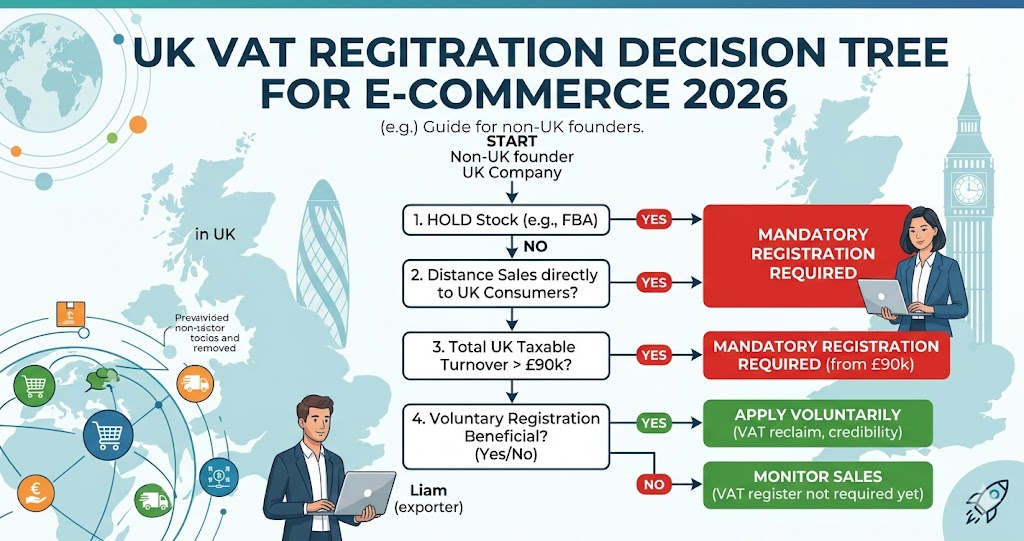
When researching UK VAT registration, most guides give you the same one-line answer: “register when you cross £90,000 in turnover.” That’s technically correct and practically useless. The real decision has three branches, and the branch you’re on depends on whether your customers are businesses or consumers, where they live, and how you sell to them.
This is the decision tree we walk founders through at Launchese — the one we wish more people had before they registered too early, missed the threshold by accident, or got caught by the Amazon FBA “stock in the UK” rule. It is general information, not tax advice — your situation will have specifics that only a UK-qualified accountant can sign off on. Use this as the map, then hire the local guide.
The £90K rule for UK VAT registration (and what “UK turnover” actually means)
UK VAT registration becomes mandatory when your VAT-taxable turnover crosses £90,000 in any rolling 12-month period. That’s the figure at the time of writing — HMRC reviews the threshold at each Budget, so check the current number at gov.uk/vat-registration-thresholds before you make a decision.
Three details matter and are constantly missed:
It’s rolling, not calendar. You’re not looking at January–December. You’re looking at any consecutive 12-month period. If May 2025 to April 2026 totalled £92,000, you’ve crossed the threshold even if no calendar year did.
It’s UK-taxable turnover, not gross revenue. Sales of goods or services that would be subject to UK VAT (had you been registered) count toward the threshold. Exports to consumers outside the UK generally do not count toward UK VAT thresholds — but the rules vary by category and destination, which is why generic answers fail here.
You also have to look forward, not just back. If you can reasonably expect to cross £90,000 in the next 30 days alone (a viral launch, a big B2B contract), you must register based on the forward-looking test even if your past 12 months are well below the threshold.
For an international founder running a UK Ltd from abroad, “UK turnover” is where things get confusing fastest. The location of your customer, the location of your stock, and whether you sell goods or digital services all change which sales count. We’ll come back to the edge cases below.
Q1: Are you over £90,000? Then UK VAT registration is mandatory
If your rolling 12-month VAT-taxable turnover has crossed the threshold, you have 30 days from the end of the month you crossed in to notify HMRC. Miss that window and the penalties compound fast: a percentage of the VAT you should have collected, scaled by how late you are, plus interest on the unpaid VAT itself. Voluntary disclosures get treated more leniently than HMRC discovering the omission first.
To register, sign in to your Government Gateway account (or create one) and use the VAT registration service at gov.uk/register-for-vat. You’ll need: your UK Ltd’s company number, your UTR, your business bank account details, an estimate of your annual taxable turnover, and your director information matching Companies House.
HMRC’s stated processing time is 30 working days but in 2026 it’s commonly running closer to 40–45 days. During that window you cannot legally charge VAT (you don’t have a number yet) — but you should price as if you were registered, then issue VAT invoices retrospectively once your number arrives. Your accountant will walk you through the bridge accounting, and we strongly recommend having one in place before you submit the application.
HMRC’s official guidance is the source of truth here — see gov.uk/vat-registration.
Q2: Under £90,000 and selling B2B? Voluntary registration usually wins
This is the branch most international founders miss. If your customers are mostly other VAT-registered UK businesses — agencies serving clients, B2B SaaS, wholesale, consultancy — voluntary UK VAT registration is often the financially better choice even though you’re below the mandatory threshold.
Three reasons:
You reclaim input VAT. Every time you buy something for the business — laptops, software subscriptions, ads, professional services — you’re paying 20% VAT to your suppliers. Without registration, that’s a sunk cost. With registration, you reclaim it quarterly. For a typical small UK e-commerce or services business, reclaimable input VAT can run to several thousand pounds a year.
Your B2B customers don’t care that you charge VAT. Adding 20% to a £1,000 invoice means your customer pays £1,200, then reclaims the £200 themselves on their own VAT return. Net effect on them: zero. Net effect on you: you’ve collected VAT (which you remit to HMRC) and you can now reclaim your own input VAT (which lowers your costs).
Perceived professionalism. In the UK B2B world, “VAT registered” reads as a signal of legitimate scale. It’s a small thing — but B2B procurement teams notice the absence.
The voluntary B2B case isn’t universal. If you’re early-stage with very low input VAT and you’re paid in advance by clients, the cash-flow timing can hurt. Have your accountant model both scenarios with your actual numbers before deciding.
Q3: Under £90,000 and selling B2C? Usually, don’t register voluntarily
If your customers are consumers, a Shopify store, a TikTok Shop, or Amazon FBA, voluntary UK VAT registration is usually the wrong call. The maths is unforgiving.
Imagine you sell a product for £30. Not registered, you net £30 (less cost of goods, fees, etc.). Voluntarily registered, you have two choices: keep your sticker price at £30 and absorb the VAT (so HMRC takes £5 of your £30) or raise your price to £36 to preserve your margin (at which point you’re 20% more expensive than your unregistered competitor on the same shelf).
Consumer-facing markets are price-sensitive. A 20% retail price disadvantage against an otherwise identical unregistered competitor is almost always fatal to conversion rate. The input VAT you’d reclaim — usually small as a percentage of revenue in low-margin e-commerce — doesn’t come close to compensating.
The exception: if you’re confident you’ll cross £90,000 in the next 12 months anyway, registering early (with prices set for the post-registration economics from day one) avoids the rebrand-and-reprice pain when the threshold catches up to you. That’s a strategic decision, not a tax decision — work it through with your accountant.
VAT is only one of several compliance flags Stripe checks before approving an account.
VAT is only one of several compliance flags Stripe checks before approving an account.
Run your storefront through our free scanner — it catches the issues that get accounts frozen during the underwriting review.
Run our free Stripe Compliance Scanner →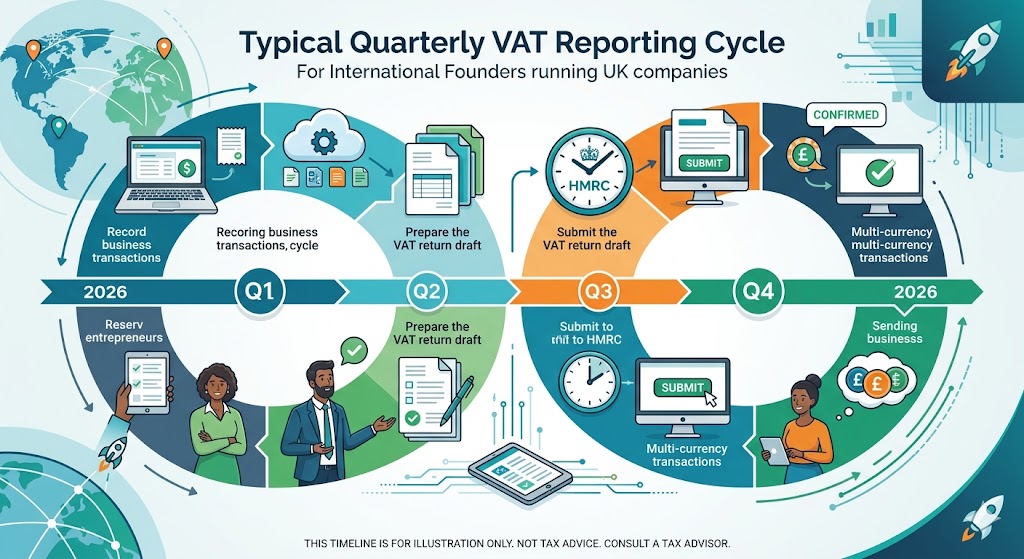
How to complete your UK VAT registration, step by step
Once you’ve decided registration is right for your business, the process itself is straightforward:
- Sign in to Government Gateway. Use the same account you used to register your UK Ltd. If you formed your company with Launchese, your gateway credentials were created during incorporation.
- Start the VAT registration application. Available at gov.uk/register-for-vat. You’ll need your company number, UTR, business bank details, and an estimate of your taxable turnover.
- Pick your VAT scheme. Most small e-commerce businesses use the Standard scheme. The Flat Rate Scheme can be simpler administratively but rarely works out better financially for goods-based e-commerce since 2017’s rule changes. The Cash Accounting Scheme helps cash-flow if you have slow-paying customers. Your accountant should advise on which fits.
- Set up MTD-compliant software. Making Tax Digital rules mean you can’t file VAT returns via a spreadsheet anymore — you need software that connects directly to HMRC. Xero and QuickBooks Online are the two most common choices for UK e-commerce. Set this up before your VAT number arrives, not after.
- Wait for your VAT number. Currently, 30–45 days from submission. HMRC will post the certificate to your registered office address.
What changes in your business after UK VAT registration
From your effective registration date forward, four things change in your business operations:
You charge VAT on UK sales. Most goods and services are at the standard rate of 20%. Some categories (children’s clothing, most food, books) are zero-rated or reduced — your accountant will map your specific product mix to the right rates.
You issue VAT invoices. Every sale to a VAT-registered customer needs a compliant VAT invoice showing your VAT number, the net amount, the VAT amount, and the gross. Most e-commerce platforms (Shopify, WooCommerce, Stripe, Xero) handle this automatically once you flip the registration switch.
You file quarterly VAT returns. Four returns a year, each covering a 3-month period, each due roughly one month and seven days after the period ends. Returns are submitted through your MTD-compliant software, which talks directly to HMRC.
You operate on a refund cycle for input VAT. Each quarter, you net your output VAT (what you’ve collected from customers) against your input VAT (what you’ve paid to suppliers). If the output is higher, you pay the difference to HMRC. If input is higher — common for businesses with heavy upfront investment — HMRC pays you the difference, usually within 30 days.
VAT registration starts with a registered UK Ltd.
If you don’t have one yet, we’ll get you incorporated, set up with banking and an introduction to a UK accountant who works with international founders. Get your UK Ltd in 4 weeks — Book a free call →
VAT registration starts with a registered UK Ltd.
If you don’t have one yet, we’ll get you incorporated, set up with banking and an introduction to a UK accountant who works with international founders.
Get your UK Ltd in 4 weeks — Book a free call →Trusted by 10,000+ founders from 100+ countries
Common mistakes that catch founders out
Five we see again and again:
- Rushing UK VAT registration on day one “to look professional”. If you’re B2C and a long way from the threshold, you’ve just added a 20% disadvantage versus unregistered competitors. Voluntary registration is a financial decision, not a vanity one.
- Tracking calendar year, not rolling 12 months. Founders look at their year-to-date numbers in October and think they’re safe. Then November–April of the previous year combined with May–October of this year puts them over £90,000 and they missed the registration deadline. Set up a monthly trailing-12 turnover check in your accounting software.
- Forgetting the forward-looking test. A signed B2B contract worth £80,000 in the next 30 days alone triggers immediate registration, regardless of your past 12 months. The signature date is what matters.
- Using non-MTD software. Filing your VAT return from a spreadsheet was banned several years ago, but founders still try and then panic when HMRC rejects the submission. Get on Xero, QuickBooks, FreeAgent or a similar MTD-compliant platform before you register.
- Not accounting for Amazon FBA stock-in-UK rules. Covered in the next section — but this catches a meaningful share of international founders who didn’t realise that placing stock in a UK Amazon warehouse changes their VAT exposure on day one.
For a wider view of the operational decisions that decide whether an e-commerce business survives the first year, read The Hidden Truth: Why 90% of Dropshippers Fail.
Special UK VAT registration cases: digital products, EU OSS, Amazon FBA
Three categories where the standard “£90K threshold” rule needs adjustment.
Digital products to UK consumers. SaaS, ebooks, courses, downloadable software, digital design assets. UK place-of-supply rules apply: if you sell B2C digital services to a UK consumer, the supply is treated as taking place in the UK. Your UK Ltd is subject to the standard threshold rules. Sales of the same products to UK business customers (B2B) generally use the reverse charge mechanism — the customer accounts for the VAT, not you.
Selling into the EU post-Brexit. The EU One Stop Shop (OSS) scheme lets you register once and report VAT on B2C sales across all 27 EU member states. The pan-EU threshold for distance selling into EU consumers is €10,000 across all member states combined — much lower than the UK domestic threshold. Above it, you must collect VAT at the destination country’s rate. The OSS scheme is the simpler administrative path; the alternative is registering individually in each member state where you have sales. Speak to a cross-border VAT specialist for any meaningful EU volume.
Amazon FBA with stock held in UK warehouses. This is the rule that catches the most international founders. The moment Amazon places your inventory in a UK fulfilment centre, you are deemed to be making supplies of goods located in the UK. For non-UK-established businesses, there is no £90,000 threshold for this — registration is required from your very first sale. This is unique to non-resident sellers and a long way from the “register at £90K” headline. If your fulfilment strategy includes Amazon FBA UK or a UK third-party warehouse, get accountancy advice before you ship stock in.
For a wider context on running a UK Ltd as a director — including how dividends and salary interact with VAT and corporation tax — see our sister post on the director’s loan account.
No UK Ltd, no VAT registration.
Get the entity sorted first. Everything else — bank, payments, VAT, accounting — flows from there.Start your UK Ltd from £49 →
No UK Ltd, no VAT registration.
Get the entity sorted first. Everything else — bank, payments, VAT, accounting — flows from there.
Start your UK Ltd from £112 →Frequently asked questions
What is the current UK VAT registration threshold?
At the time of writing, the threshold is £90,000 of rolling 12-month VAT-taxable turnover. The figure is reviewed at each UK Budget — confirm the current number at gov.uk/vat-registration-thresholds before making any decision.
Can I deregister later?
Yes. If your VAT-taxable turnover drops below the deregistration threshold (£88,000 at the time of writing) and you reasonably expect it to stay there for the next 12 months, you can apply to deregister. There are also rules around ceasing to trade and changing business structure that allow earlier deregistration. Speak to your accountant — there’s paperwork to do at the boundary.
Do I charge UK VAT on sales to EU consumers?
Generally, no exports of goods from the UK to consumers in the EU are zero-rated for UK VAT, but the destination country’s VAT typically applies and is what triggers the EU OSS conversation. The exact treatment depends on the value of the order, the type of goods, and where the goods are physically shipped from. This is the area where most international founders need cross-border specialist advice.
What about Amazon FBA?
If your stock is held in a UK fulfilment centre, non-UK-established businesses must register for VAT from the first sale — there’s no £90K threshold for this case. Amazon’s UK Seller Central will not let you trade as a non-resident without a UK VAT number once your goods are in a UK FBA warehouse. Build VAT registration into your launch timeline if FBA UK is part of your model.
Do I need an accountant to register for VAT?
You can do the registration yourself on the Government Gateway. What you actually need an accountant for is the decision (which branch of the tree applies to you), the MTD software setup, and the quarterly returns once you’re registered. Trying to run UK VAT returns without an accountant is a false economy — the first time you get the input/output split wrong, you’ll have paid for one anyway.
This article is general information for international founders evaluating UK VAT registration. It is not legal, tax or financial advice. UK VAT rules change regularly — always verify current thresholds and processes at gov.uk and consult a UK-qualified accountant or tax adviser about your specific situation before registering or making any tax-related decision.