

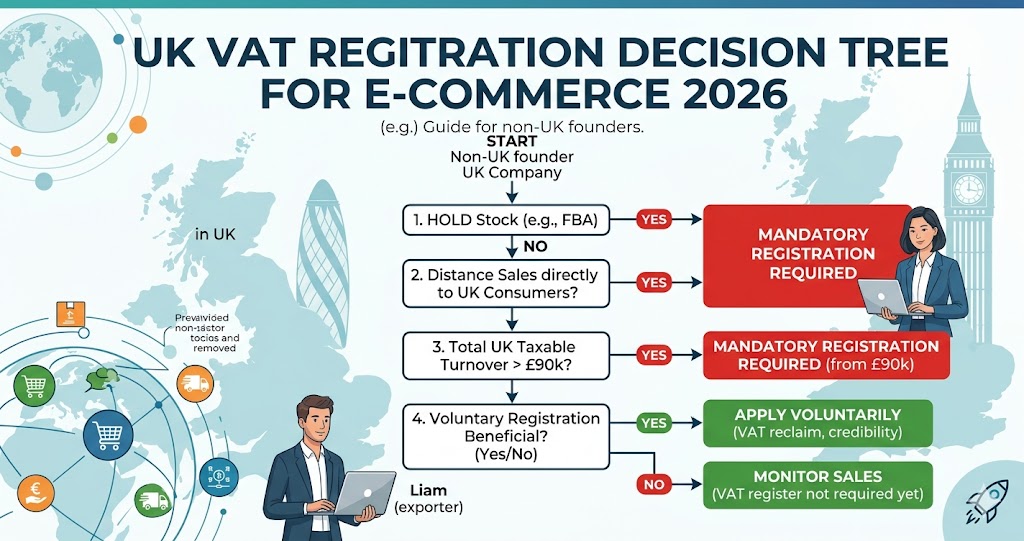
This article is general information for international founders researching UK VAT registration. It is not legal, tax or financial advice. UK VAT rules change regularly. Always verify current thresholds and processes at gov.uk/vat-registration and consult a UK-qualified tax adviser about your specific situation before making any VAT-related decision.
VAT registration UK rules work very differently for non-resident founders than for UK-based businesses, and the most important distinction is whether your company is UK-established or a non-established taxable person (NETP). The £90,000 threshold that most guides lead with applies only to UK-established businesses. If HMRC treats your company as an NETP, there is no threshold at all, and you must register from your very first taxable supply in the UK. Getting this wrong is expensive.
This guide covers the triggers, the thresholds, the official registration process, the distinction between a VAT representative and a VAT agent, what happens after you register, and when you can deregister. The goal is to give you a clear map before you speak to a UK tax adviser about your specific position.

Do you need to register for VAT in the UK? The 3 triggers
Three situations put you inside the UK VAT net. Only one of them is a choice.
1. Mandatory: taxable turnover exceeds the £90,000 threshold (UK-established businesses only)
If your UK-taxable turnover passes £90,000 in any rolling 12-month period, you must register. “Rolling” is the catch: HMRC looks at any consecutive 12 months, not your accounting year or the calendar year. Check the running total every month.
The 30-day forward-look rule. You do not have to have already crossed the threshold to be caught. If at any point you reasonably expect your taxable turnover to exceed £90,000 in the next 30 days alone, you must register immediately, before those sales happen. A signed contract worth £100,000 due to complete next month triggers registration on the day you sign. Source: gov.uk/vat-registration.
Notification deadline (historical crossing). If you have already crossed £90,000 in the past 12 months, you must notify HMRC by the end of the month following the month you crossed. For example: you cross in June, you notify HMRC by 31 July. Missing that window triggers penalties. Source: HMRC VAT Notice 700/1 (gov.uk).
This threshold applies only to UK-established businesses. If your company is an NETP, see trigger 2 below.
2. Mandatory for non-established taxable persons (NETPs): nil threshold
A non-established taxable person is any business that makes taxable supplies in the UK but has no UK establishment. NETPs must register for UK VAT from their very first taxable supply in the UK, regardless of value. There is no £90,000 cushion. Source: gov.uk/vat-registration, HMRC VAT Notice 700/1 para 9.2.
The critical point for UK Ltd owners: forming a UK limited company does not automatically make you UK-established for VAT purposes. Per HMRC VAT Notice 700/1 para 9.2, a registered office, serviced office, or virtual office address is not sufficient to constitute a UK establishment. To be treated as UK-established, your company needs a genuine fixed place of business with human and technical resources used to make or receive supplies on a permanent basis, for example a real operating office with staff on the ground, or a warehouse with active operations.
Many non-resident founders run their UK Ltd entirely from abroad, using only a registered or virtual address in the UK. In that situation, HMRC may treat the company as an NETP, applying the nil threshold. Do not assume a UK Ltd equals UK-established. Confirm your status with a UK VAT adviser before making any registration decision.
3. Voluntary registration
Any business can register before hitting any threshold. Common reasons: reclaiming input VAT on startup costs (software, equipment, professional fees), presenting a VAT invoice to UK B2B customers, and getting affairs in order before the threshold is imminent.
One note on payment gateways: a VAT number is a tax registration, not a payment-gateway credential. Launchese is not affiliated with Stripe or PayPal. Whether and how a VAT number affects a Stripe or PayPal application is determined entirely by those providers’ own policies, and is outside HMRC’s scope and outside Launchese’s control.

VAT registration threshold UK: what counts and what doesn’t
The 2026 registration threshold is £90,000 of taxable turnover in any rolling 12-month window, up from £85,000 on 1 April 2024. The deregistration threshold is £88,000 (applies to UK-established businesses only; see the deregistration section below). Source: gov.uk/vat-registration-thresholds.
Not every pound of revenue counts. Here is the breakdown:
| Supply type | VAT rate | Counts toward threshold? |
|---|---|---|
| Standard-rated | 20% | Yes |
| Reduced-rated | 5% | Yes |
| Zero-rated | 0% | Yes |
| Exempt | No VAT | No |
Zero-rated and exempt are not the same thing. Zero-rated supplies are taxable at 0%, count toward the threshold, and allow you to reclaim input VAT. Exempt supplies (certain financial services, insurance, education) carry no VAT, do not count toward the threshold, and do not allow you to reclaim VAT on related costs.
UK establishment vs non-established taxable person: the most important VAT question for non-resident founders
This is where the guidance most guides give you breaks down. The question is not simply “do I have a UK Ltd?” The question is: does your UK Ltd have a genuine UK establishment?
What HMRC says about virtual and registered offices. HMRC VAT Notice 700/1 para 9.2 is explicit: a registered office address, a serviced office, or a virtual office does not in itself constitute a UK establishment for VAT purposes. The notice is available at gov.uk.
What does constitute a UK establishment. To be UK-established for VAT, your company needs a fixed place of business where it has, on a permanent basis, both the human resources (people) and the technical resources (equipment, infrastructure) it uses to make or receive its supplies. A real operating office with employees, or a warehouse with active fulfilment operations and staff, can qualify. A mailbox at a registered address cannot.

Practical examples:
- UK Ltd whose sole director works from abroad, with a registered office address provided by a formation agent, and no UK employees or operations: likely treated as an NETP. Nil registration threshold applies.
- UK Ltd with a rented UK office, a UK-based employee managing day-to-day operations, and regular supplies made from that location: likely UK-established. The £90,000 threshold applies.
The burden is on you to understand your status. If you are uncertain, seek advice from a UK VAT specialist before registering, as registering under the wrong rules can create compliance problems in both directions.
How to register for VAT UK: the official online route, step by step
UK VAT registration is free. HMRC charges no fee. The standard route is online through the Government Gateway, using HMRC’s VAT registration service at gov.uk/register-for-vat. This replaced the old paper VAT1 form for most applicants.
- Set up or sign into your Government Gateway account. Use the same account you use for corporation tax. If you registered for corporation tax in the UK already, you have one.
- Start the online VAT registration. You will provide your company details, business activity, estimated taxable turnover, bank account details, and the date your VAT liability started.
- Declare your establishment status. If you are registering as an NETP, you must state this during the application. The process includes additional steps for non-established businesses.
- Submit and wait. HMRC asks you to allow 40 working days before contacting them about your application. Source: HMRC VAT Notice 700/1 para 4.5. Do not expect 2 to 4 weeks, and do not expect 30 working days: 40 working days is HMRC’s stated guidance.
- Receive your VAT registration certificate (VAT4). This confirms your VAT number, your effective date of registration, and when your first return is due. HMRC sends it to your registered office address.
- Display your VAT number. Once issued, your VAT number must appear on your website, your invoices, and your business correspondence. Omitting it is a compliance failure.
Launchese can assist with the VAT registration process. See the available options at launchese.com/plans.
VAT representative vs VAT agent: an important distinction
These two roles are frequently confused, and the difference matters legally.
A VAT representative is a UK-resident person or business who registers alongside an overseas or NETP business and becomes jointly and severally liable for that business’s UK VAT debts. If the overseas business fails to pay, HMRC can pursue the representative for the full amount. This is a legally significant commitment. HMRC may require or encourage NETPs to appoint a VAT representative. The requirement depends on the specific circumstances of the overseas business.
A VAT agent is an accountant, adviser, or other representative who handles your VAT registration, returns, and dealings with HMRC on your behalf. A VAT agent takes on no personal liability for your VAT debts. This is the much more common arrangement.
These roles are distinct. Do not treat them as interchangeable when arranging your VAT affairs. If you are an NETP or uncertain about your status, seek specialist advice on whether HMRC will require you to appoint a VAT representative.
Voluntary VAT registration UK: when it pays off and when it doesn’t
You do not have to wait for the threshold to register. Voluntary registration makes financial sense in some situations and not others.
When voluntary registration tends to make sense:
- Your sales are predominantly B2B to UK-registered businesses. Those customers reclaim the VAT you charge, so the 20% addition is neutral to them, while you gain the right to reclaim your own input VAT.
- You have significant startup costs with VAT on them: equipment, software, office setup, professional fees. Registration lets you reclaim that VAT.
- You are confident you will cross the threshold within 12 months and want to price from day one on the post-registration economics.
When voluntary registration usually does not make sense:
- Your customers are consumers (B2C). They cannot reclaim VAT, so your effective price rises by 20% unless you absorb it and cut your margin.
- You are in an early, low-revenue stage with minimal input VAT to reclaim and no near-term threshold crossing in sight.
Once registered, you must charge VAT on all UK-taxable supplies, file quarterly returns, and remit the net amount to HMRC. The administrative and cash-flow burden is real. Have a UK accountant model both scenarios against your actual numbers before deciding.
On payment gateways: a VAT number may be one factor payment gateways consider among many. Launchese is not affiliated with Stripe or PayPal, and cannot guarantee any outcome regarding payment gateway applications. Any claim that a VAT number secures gateway approval would be inaccurate.
Distance selling, EU VAT, and digital services
Selling digital services or goods to consumers in EU countries is a separate system from UK VAT. A UK business selling B2C into the EU can use the EU One Stop Shop (OSS), registering in a single EU country to handle VAT across all member states rather than registering in each one individually. That is EU VAT, governed by EU rules, and runs alongside your UK VAT registration as a separate obligation. It is outside the scope of this guide; speak to a cross-border VAT specialist if EU consumer sales are significant for your business.
The VAT Flat Rate Scheme
If your taxable turnover is below £150,000, you may qualify for the Flat Rate Scheme. Instead of calculating VAT on every individual transaction, you pay a fixed percentage of your gross turnover to HMRC. It simplifies administration, though whether it saves you money depends on your cost structure. For the full analysis, see the VAT Flat Rate Scheme UK guide.
After registration: your ongoing VAT obligations
Your VAT number is not the finish line. These obligations run from your effective date of registration:
- Charge VAT at the correct rate. Standard rate is 20%. Some supplies are 5% or 0%. Know which rates apply to your products or services.
- Issue compliant VAT invoices. Every VAT invoice must show your VAT number, the net amount, the VAT rate, the VAT amount, and your registration details.
- File VAT returns. Normally quarterly, though monthly and annual options exist for some businesses.
- Follow Making Tax Digital (MTD) for VAT. MTD has been mandatory for all VAT-registered businesses since April 2022. You must keep digital records and submit returns through HMRC-compatible software (Xero, QuickBooks, FreeAgent, and others qualify). Filing from a spreadsheet is not permitted. Source: gov.uk/making-tax-digital-for-vat.
- Pay HMRC on time. Late payment triggers a points-based penalty system and interest charges.
- Display your VAT number. On your website, all invoices, and your business correspondence.
VAT is a separate obligation from corporation tax. You still need to pay corporation tax in the UK on company profits, on a different deadline and a different return. These are two distinct compliance tracks.
VAT deregistration: the rules differ by establishment status
Deregistration rules are not the same for UK-established businesses and NETPs, and this is an area where many guides give incomplete information.
UK-established businesses can apply to deregister if their taxable turnover falls below the deregistration threshold of £88,000, or if they reasonably expect it to fall below £88,000 in the next 12 months. They can also deregister if they stop making taxable supplies entirely. Source: gov.uk/register-for-vat/cancel-your-registration.
NETPs cannot use the £88,000 deregistration threshold. The £88,000 threshold does not apply to non-established taxable persons. An NETP can only deregister once it has stopped making taxable supplies in the UK altogether. If you are an NETP and your UK sales drop below £88,000 but continue, you remain obligated to stay registered. This is a significant difference from the rules that apply to UK-established businesses. Source: VAT Notice 700/1.
FAQ: UK VAT registration for non-resident founders
Can a non-resident register for VAT in the UK?
Yes, there is no residency requirement. However, your VAT obligations depend on whether your UK Ltd is UK-established or an NETP. If your company has a genuine UK fixed place of business with staff and resources, the £90,000 threshold applies. If your only UK presence is a registered or virtual office, HMRC may treat the company as an NETP, in which case you must register from your first taxable supply and there is no threshold. Confirm your status with a UK tax adviser before registering.
How long does UK VAT registration take?
HMRC asks you to allow 40 working days before contacting them about your application. Source: HMRC VAT Notice 700/1 para 4.5. Earlier figures of 2 to 4 weeks or 30 working days are no longer current.
What is the VAT registration threshold in 2026?
£90,000 of taxable turnover in any rolling 12-month period (up from £85,000 on 1 April 2024). This threshold applies only to UK-established businesses. NETPs have a nil threshold and must register from their first taxable supply. The deregistration threshold is £88,000, and it also applies only to UK-established businesses. Source: gov.uk/vat-registration-thresholds.
Does a UK Ltd automatically mean I am UK-established for VAT?
No. Per HMRC VAT Notice 700/1 para 9.2, a registered office, serviced office, or virtual office address is not sufficient to make your company UK-established for VAT purposes. To be treated as UK-established, you need a genuine fixed place of business with human and technical resources used on a permanent basis to make or receive supplies. Many founders running a UK Ltd from abroad with only a virtual address will be treated as NETPs. Confirm your status with a UK VAT adviser.
What is the difference between a VAT representative and a VAT agent?
A VAT representative takes on joint and several liability for your UK VAT debts: a legally significant role that HMRC may require for certain NETPs. A VAT agent (typically an accountant or adviser) handles your returns and dealings with HMRC on your behalf but has no personal liability for your VAT debts. These are distinct roles. Do not treat them as interchangeable.
What is the difference between zero-rated and exempt supplies?
Zero-rated supplies are taxable at 0%, count toward the £90,000 registration threshold, and allow you to reclaim input VAT. Exempt supplies carry no VAT, do not count toward the threshold, and do not allow you to reclaim VAT on costs directly linked to them.
Can I deregister for VAT if my turnover falls?
It depends on your establishment status. If you are UK-established, you can apply to deregister if your taxable turnover falls below £88,000 or you reasonably expect it to do so. If you are an NETP, the £88,000 deregistration threshold does not apply to you. An NETP can only deregister once it has stopped making taxable supplies in the UK altogether. Source: VAT Notice 700/1; gov.uk/register-for-vat/cancel-your-registration.
Does a VAT number guarantee Stripe or PayPal approval?
No. A VAT number is a tax registration, not a payment-gateway credential. Launchese is not affiliated with Stripe or PayPal. Whether or how a VAT number affects a payment gateway application is entirely within those providers’ own policies and is outside HMRC’s scope and Launchese’s control.
This article is general information for international founders researching UK VAT registration. It is not legal, tax or financial advice. UK VAT rules change regularly. Always verify current thresholds and processes at gov.uk/vat-registration and consult a UK-qualified tax adviser or accountant about your specific situation before registering or making any VAT-related decision.


